Showing posts with label abs. Show all posts

Monday, March 15, 2010

Strengthening the Core


The “core” of your body – the muscles in and around your back and abdominals – is crucial to your overall strength. Just as the core of an apple supports the surrounding fruit, so your overall body weight will not be well-supported without a strong core. Good posture, sitting, standing, and really any type of movement all require a strong core.

Core Muscles Work Together

If you suffer back pain, pain while sitting or standing, or persistent pain in the lower neck area, your core area could be weak, or you may have strengthened muscles in one area of your core while neglecting the others. The muscles throughout your core area work together, and strengthening just one area may put additional strain on the other muscles. So when you strengthen your core, it is a good idea to do a variety of exercises that will keep your core muscles wrapped tightly around your body to give it support.

The Muscles and How to Keep Them Strong

Starting at the top, the erector spinae muscles run from your neck to your lower back, and help provide good, upright posture. When these muscles are weak, your back will tend to slump or stoop, and eventually you will experience back pain as a result. One way to strengthen these muscles is to lie on your stomach with hands clasped behind your head, and slowly lift your head and upper body off the floor, then return to the resting position.

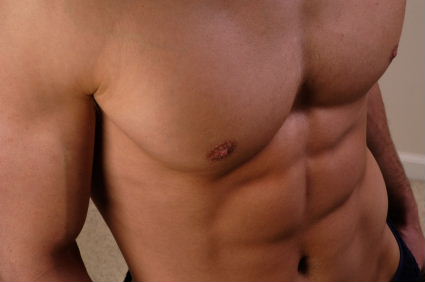
The rectus abdominis muscles are the famed “six pack” abs that so many people prize. Luckily, these muscles are just beneath the skin, so when excess fat is lost and the muscles are improved, they display quite nicely. Crunch exercises are a great way to strengthen these muscles, and the crossover crunch, where you twist to one side while crunching, will strengthen the internal oblique muscles, which lie just to the side of the rectus abdominis muscles.

Still farther to the side, near the outside of your body, are the external oblique muscles. Arm sweep exercises are quite effective at strengthening this important muscle group. Simply sit on the floor with knees slightly bent and extend your hands to your side. Lean back just a bit, until you feel your abs contract. Now, sweep your left hand back and twist that way with your upper body. Return to center and repeat the exercise on your right side. Remember not to twist too much, or the benefits of the exercise will be lost.

Deep within your core are the transverse abdominis muscles, or TVA muscles. These muscles are the closest to your spine and are critical for support, stability, and pain-free movement. A great way to strengthen these muscles is the plank exercise, where you keep your body straight while raised up on your forearms.

The core of your body is where all strength begins, and it is critical to all types of movement and strength conditioning that this portion of your anatomy be strong and healthy. A few minutes a day of focus on your core will pay benefits for years to come in improved posture and lower pain levels.

For more information, visit: UltraFitnessDynamics

Sunday, January 3, 2010

The Science Behind Great Abdominals

6-pack-abs

If you had a penny for every advertisement promising great abdominals, you would be very wealthy indeed. In fact, you would never have to worry about your abdominal muscles because you could literally pay another person to worry about them for you. But until that day comes, attainment of toned abdominal muscle remains a goal for many as a sign of youth, vitality, and sexuality.

The Role of Cortisol

'Men's Fitness', inundated with pleas from readers, decided to set the record straight about the complex but manageable process behind obtaining the coveted six-pack. First and most importantly, they decry any notions of quick fixes. Rather, the article notes that it takes dedication, time and a sensible diet of nourishing food, as well as the right exercises following a precise methodology.

Bodybuilding is a combination of weight loss and muscle development; however, to actually see the muscle definition, the overlying fat must first be eliminated. The best way to accomplish this objective is not only by consuming fewer calories than are required by the body, but also through a workout that involves the entire body, not simply the midriff. It is also imperative not lift weights or perform a strenuous workout every day. Another rule of thumb is to limit workouts to an hour or less.

Over an hour into a heavy workout of weightlifting, the body begins to secrete cortisol, the so-called ‘stress hormone'. Cortisol is the hormone that causes the fight or flight reflex; however, an influx of excessive cortisol causes the body to begin to break down muscles.

What About Crunches?

Crunches, although excellent for toning muscles in the abdominal region, in and of themselves burn few calories. According to a study at the University of Virginia, one would have to do 250,000 crunches simply to burn just one pound of fat.

Fat is burned when a hormone called epinephrine is secreted into the body. A specific type of fat, triglycerides, are burned by an enzyme called lipase. Lipase ceases to be active when a person sits, as discovered in a recent medical study ('Sitting time and mortality from all causes, cardiovascular disease, and cancer' (Katzmarzyk, P.T., et al.; 2009)). Interestingly, crunches and sit-ups are traditionally performed in a seated position.

Core Fitness

The abdominal muscles comprise a portion of an area termed by trainers as 'the core', which stretches from shoulders to hips. To tone abs with traditional abdominal exercises, a better option would be to target the entire core by performing crunches or sit-ups on an exercise ball (sometimes called a Swiss ball) to force the body to balance the muscles while performing the exercises, thus burning more calories and toning the wider muscle group including the abdominals. Additionally, such exercises should ideally be accompanied by lower back exercises to reduce the chance of injury caused by the all too common strong abdominal and weak back muscles.

Naturally, all these exercises will be for naught if a healthy diet is not followed. Bodybuilders tend to eat vast quantities of protein for the simple reason that protein helps to build muscle. However, it is essential to understand that not all forms of protein are equally healthy or beneficial for the body: unprocessed lean proteins, high-quality protein powders or meal replacement powders are key. The equation is simple, though substantial discipline is required to follow through: the right protein and the right exercises lead to award-winning abdominals.


For all there is to know on super fitness, visit UltraFitnessDynamics